

 Creating .PST files in Microsoft Outlook 2007 and Outlook 2003 is very simple. Because a reader recently asked for help with the task, I figured it deserved a quick How-To Article. Before we dive into “How-To” create .PST files, you might want to quickly review an article I just wrote which explains what is an Outlook Person Data file or .PST file and what would you want to use them.
BTW – Although my screenshots and steps were from Outlook 2007, the process for Outlook 2003 is very similar and you should be able to follow along.
How-To Create a .PST Using Outlook 2003 or Outlook 2007
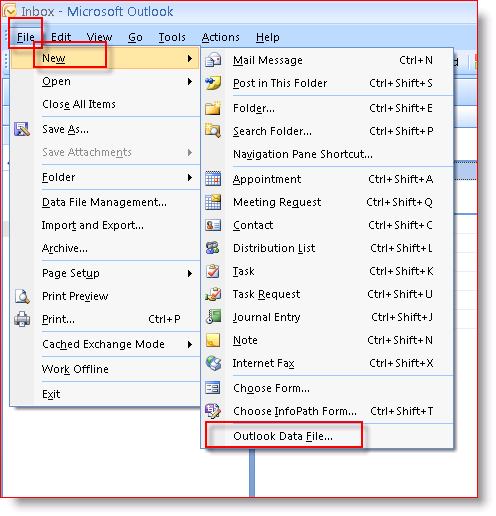
1: From Outlook, Click File, New, Outlook Data File
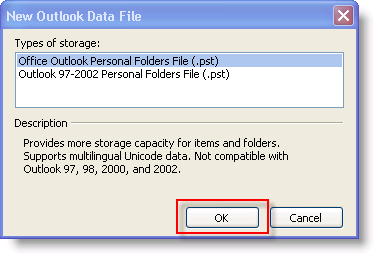
2: Keep Default Setting – Office Outlook Personal Folders File (.pst) and Click OK
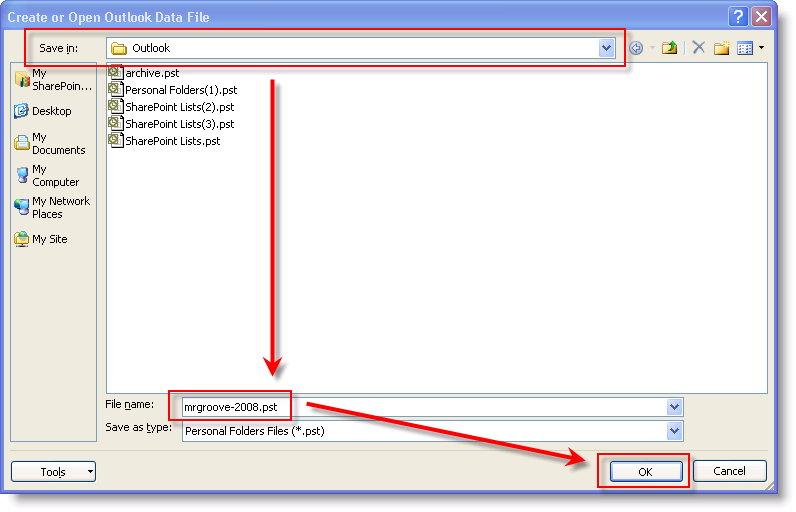
Note: In Step 3, you will need to decide where to SAVE the new .PST file. By default, new .PST files are saved:
- Windows Vista & Windows Server 2008: C:\Users\MrGroove\AppData\Local\Microsoft\Outlook\
- Windows XP: C:\Documents and Settings\MrGroove\Application Data\Microsoft\Outlook\
3: Verify location to save .PST file, Type File Name for .PST file (I organize by Mailbox Name and Year), Click OK
4: In the Name Field, Type Display Name. Use the name you want Outlook to display. Click OK

Note: Optionally, you can also enter a Password here to improve Security. Before Outlook 2007, adding a Password to a .PST file was worthless due to a flaw which allowed the Security to be defeated instantly using Security Password Cracking Products, no matter how long or complicated the password was. I’ve not tested to see if Microsoft fixed this Issue in Outlook 2007 but once I do, I’ll update the article.
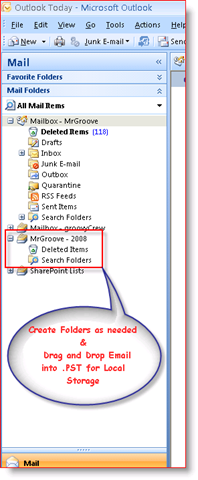
5: New .PST or Local Personal Data Folder will display in your Navigation Pane after Step 4, as shown in the Screen Snip Below. Expand the Personal Data File you created and Right Click on Personal Data File (MrGroove – 2008 in my example) to begin creating additional folders, calendars, etc. Drag and Drop also work OR, you can Cut and Paste Emails or Folders of Emails from your Server Mailbox to your new .PST Personal Data Folder. It’s pretty simple.
Pretty straight forward BUT, if you have any questions, comments, etc., or if you’re looking for more information on .PST Files or Outlook Data Files, take a look at my article https://www.groovypost.com/howto/microsoft/outlook/what-are-outlook-pst-files-and-why-use-them-or-not/. A lot of good GROOVY information regarding .PST files and their use.
50 Comments
Leave a Reply
Leave a Reply







jagan
July 23, 2008 at 4:33 am
This is really a good article .. you just no need to read also … simply you can just follow the arrows and your work will be done …
Great man
sensee sherman
November 26, 2011 at 12:44 am
ooh yes you gust me the answer i been looking for.
but how can i direct the pst file to a local server running 2003 to be save?
MrGroove
July 28, 2008 at 9:59 pm
Thanks Jagan ;)
Overseer
August 14, 2008 at 5:53 am
great website – Thumbs up to all those who keep this site going!!
vwcarter
September 25, 2008 at 8:55 pm
Thanks for the info. I am trying to transfer an old Outlook 2003 .pst file from my old desktop to my new Vista laptop. I have been able to create a second .pst file on the new laptop that I can view from the outlook program on my laptop. However I can not figure out how to get the data from the old .pst file to show up in my secondary .pst visible from outlook. When I click File- Open- Outlook Data File, there are 3 files visible. Two of them show-up w/ no file extension and are the two visible psts when I look at Outlook via the user interface. The third file shows up w/ a .pst file extension but does not show up at all via the user interface. This third file is the file that contains all my old data that I am trying to “import”. My goal is to have 2 psts in my new Outlook—one w/ all my data from here forward and one w/ all my data from my old computer that I will use as an archive. Any help on this is appreciated! I thought I could create the new pst on my laptop and copy the .pst data file from my laptop into it. However it is not allowing me to copy into it. Just shows up as the 3rd file. Thanks again.
nani
February 14, 2009 at 12:20 pm
hi it is great super
AJ
August 31, 2009 at 12:15 pm
I love the post unfortunately, I had alreadey created pst folders, now I’m a little confused as I did not name them correctly. I have always used subfolders, (right click on the Inbox) easier to locate an email. I use 2003 and I need to transfer everything from outlook and a few docs. so that I can change my hard drive. I have saved my calendar.
My problem is that your files have the .pst file extension, the ones I saved just say Outlook
or Calendar. When I click to open on the Outlook file, it leads me straight into Outlook. Not sure if that is correct, and don’t want to lose any information. Any help would be appreciated.
DelnaC
May 10, 2010 at 11:01 pm
This was a great help. Thanks so much.
MrGroove
May 11, 2010 at 8:22 am
@DelnaC – Your VERY welcome! Welcome to groovyPost.com! Hope to see you around on the site and the forum.
Cliff Deniken
June 5, 2010 at 10:08 am
I don’t know why google sent me to this blog but I can say I have become more or less captivated by the blog content you have together. How much time did it take to begin to get so many users coming to your site? I am rather new to this interenet thing.
bhaskar
September 13, 2010 at 10:56 pm
good job thanks man
Barun
December 20, 2010 at 9:28 pm
It is really good to create .PST.
MrGroove
December 21, 2010 at 11:24 am
Awesome! Glad it workd out for ya Barun! Welcome to my blog and I hope to see you around the website!
Will
January 7, 2011 at 4:20 am
Thanks, doing my annual spring clean of creating a new archive. I can never remember how to create a new one!
Great guide
Mark
January 25, 2011 at 8:54 am
when I click: file -> new -> then I don’t get an option of “Outlook Data File”. ??
I have Outlook 2006, Vista
Wizler
February 24, 2011 at 8:23 am
Hi,
I receive an error when moving emails in Outlook 2007 to a PST file that I don’t have the appropriate permissions. Given myself Full mailbox rights and made myself owner of the Inbox but the error still persists. Please help!!!!!
Wizler
ssa
March 21, 2011 at 9:50 pm
its great
V
April 7, 2011 at 12:17 am
It was very helpful
leon
May 15, 2011 at 11:58 am
Newcomer to site. Tried to follow instructions to make Outlook .pst file
Want to be able back up all Outlook data on old netbook as well as transfer to new laptop
followed instructions but cannot see how to back up data using that info.
advise welcome…will also try to find community forum…if sufficiently user friendly, hopefully will do so…but if response possible by mail, thank you!
leon
May 15, 2011 at 11:59 am
Or rather, not by mail but via comment here….as I said, newcomer…and a bit jaded from hours of so far futile effort!!
Ryan
May 19, 2011 at 8:41 am
very useful information! thanks…
Sreenivas reddy
May 29, 2011 at 1:17 pm
first of all thanks for ur precious info….nice to see other groovy posts here….great:)
Kiran
June 9, 2011 at 10:29 pm
Hi, this is very thorough, clear with step wise screenshots. Any person can create .pst file just at first attempt without any doubts. thanks
Kawsar Ahmed
July 8, 2011 at 11:53 pm
Thanks for this, mate!
Soniya
July 12, 2011 at 10:40 pm
Its really gr8. I really like it. Really good article Mr. Groove. Thanks
Archana
July 12, 2011 at 10:53 pm
great help… thanks a zillion for posting this.. :)
Godzuky
July 15, 2011 at 6:50 am
Thanks for sharing this.. it was very helpful and easy to do.
Naveen Negi
August 5, 2011 at 1:13 am
Hi Groove, thank you so much, it is really helpful site.
MrGroove
August 5, 2011 at 6:16 pm
Hi Naveen – Thanks for the feedback – I’m glad you find my blog helpful! spread the word!!! :) :)
Alan
August 10, 2011 at 8:36 pm
Helped a bunch! Thanks. Zero to PST in under two minutes!!
exportost
August 12, 2011 at 2:49 am
SysTools Download OST to PST Software is helpful software uses to convert OST to PST File. This software not only offers you very developed OST Recovery Software and lofty superiority free Download OST to PST File, but also present all these advantage at a small cost.
Karen
September 8, 2011 at 11:14 am
I do not have the choice of :Outlook Data file’ in my Outlook , New, File
What do i need to do?
Erika
November 21, 2011 at 11:23 am
How do I get my emails to come out of and to my new pst folder? I keep getting messages saying I am over the size limit even after deleting everything permanently and having the pst file.
Mahesh B N
November 30, 2011 at 9:48 pm
Thanks for info.
Miguel Angel
December 28, 2011 at 10:59 am
Thanks Steve for the article. I have 3 questions here.
My .PST has 3.1GB. But I’ve noticed that when I delete useless mails, the size barely goes down.
1. So, should I create a new .PST and move the things that I want to this new file so as to get a small file?
2. The 3.1GB size is the reason Outlook is working slowly?
3. Let’s say I have 2 .PST’s that I want to “upload” to the Outlook… how is that donde? Can I do that?
Thanks in advance!
Miguel
Lorin
February 15, 2012 at 11:45 pm
OST into PST: An Outlook user want restores old emails, which is deleted by chance but important for business or personal purpose in this situation OST into PST conversion solution is very useful for Outlook user. Get more info visit-: SysTools OST Recovery Tool
mispeed
April 23, 2012 at 11:14 pm
hello together,
i have a problem…. ;(
i crashed my outlook during entering in a fresh outlook my google exchange dates…. now outlook doesnt start….
i read in a block to delete outlook and kill the complete outlook folder here ‘C:\Users\Teddy\AppData\Local\Microsoft\Outlook’…
reinstalled outlook…. nothing happened…. outlook is searching the files… but there are deleted…
can anyone upload a fresh file that i need to start outlook?
the post here is really usefull… but i cant create the file out of outlook ;(
can anyone helb me? ;)
thx
greeds
mispeed
Nirdosh rathi
May 26, 2012 at 3:58 am
Hi Groove, thank you so much, it is really helpful site.
loadedgenx
July 30, 2012 at 9:54 am
Steve, you’re too handsome to be in IT.
Steve Krause
July 30, 2012 at 9:58 am
I don’t know who you are but…. the check is in the mail!
Carla
August 22, 2012 at 3:27 pm
Thanks a bunch! You’re great at what you do!
Steve Krause
August 22, 2012 at 9:59 pm
Hi Carla — Thanks so much for the feedback. I work hard to keep great content posted up on the site. I appreciate the feedback!
Nimrod
September 13, 2012 at 6:38 am
Great Post, but check your grammar. Really takes the professional look and feel away when the auther confuses “You’re” and “Your”
hsghgfa
September 24, 2012 at 1:31 am
Hi
Rehan
May 31, 2014 at 12:43 am
Man !
you are the champ! I didn’t know it was that easy as you explained.
It worked for me.
thanks!
Priti
September 23, 2015 at 10:29 pm
i have created a pst but my mails are coming in old pst
Steve Krause
September 24, 2015 at 1:11 pm
Hi Priti – What version of Outlook are you running?
md rasool
December 30, 2015 at 9:09 pm
good one ,, to learn the end user but make sure that screen shot is clearly to veiw or not
Udaya Reddy
March 16, 2016 at 2:56 pm
Hi Grovee,
Really very helpful. Awesome jobe done by you. Thanks.
Mohamamdarif
May 31, 2016 at 8:54 pm
thank you sir you save my soul